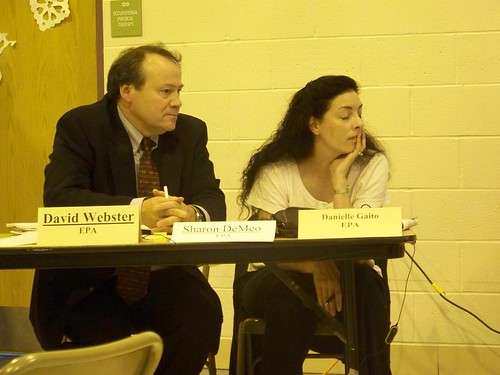
The federal Environmental Protection Agency visited Russell on August 13 to hold a hearing on a draft National Pollutant Discharge Elimination System [NPDES] permit issued to Russell Biomass. The plant is seeking permission to discharge heated and contaminated effluent into the Westfield River. (The draft permit can be found here.)
Showing posts with label biomass. Show all posts
Friday, September 4, 2009
Thursday, July 9, 2009
Fryin' Fish
Am hard at work publicizing a blog designed to unite communities nationwide that are confronting the prospect of hosting large-scale wood-burning biomass plants. Am collaborating with some folks who are working in Washington to fix HR 2454, AKA the Waxman-Markey Climate Bill.
As you've probably heard, the CO2 emitted by biomass plants falls through a carbon-accounting loophole. This CO2 is not regulated by the RGGI (Regional Greenhouse Gas Initiative), is not regulated by the US EPA, not regulated by the MA DEP, and would not be regulated under the federal cap-and-trade system as proposed.
Kicker is, wood-burning biomass plants emit more CO2 per unit of energy produced than the worst coal plants. Don't believe it? Here's some documentation.
We're being told, by government officials and entrepreneurs, that wood-burning biomass plants are "carbon-neutral." This just isn't so. Read this article if you want a quick understanding of carbon accounting as it relates to forestry products. According to the Intergovernmental Panel on Climate Change (IPCC),
“Biomass fuels are included in the national energy and CO2 emissions accounts for information only. Within the energy module biomass consumption is assumed to equal its regrowth. Any departures from this hypothesis are counted within the Land Use Change and Forestry module.”
This means that if carbon is not counted as an emission when trees are incinerated, it should at least be counted when the trees get cut down. In Massachusetts, this only happens when there is a wholesale change in land use--from forest to housing development, for instance. Heavy logging to produce biomass fuels flies under the radar of the carbon counters, as does incineration itself.
Just because the Commonwealth of Massachusetts has chosen not to count carbon emissions from wood biomass incinerators does not mean that they are "carbon-neutral."
But I digress.
I know there's a lot going on in Northampton. Will try to do my part.
But in the meantime, check out our little biomass communities blog project: we've already got readers from all over the country, and have developed an audience that includes national-level environmentalists and policy makers. It's kind of exciting.
As you've probably heard, the CO2 emitted by biomass plants falls through a carbon-accounting loophole. This CO2 is not regulated by the RGGI (Regional Greenhouse Gas Initiative), is not regulated by the US EPA, not regulated by the MA DEP, and would not be regulated under the federal cap-and-trade system as proposed.
Kicker is, wood-burning biomass plants emit more CO2 per unit of energy produced than the worst coal plants. Don't believe it? Here's some documentation.
We're being told, by government officials and entrepreneurs, that wood-burning biomass plants are "carbon-neutral." This just isn't so. Read this article if you want a quick understanding of carbon accounting as it relates to forestry products. According to the Intergovernmental Panel on Climate Change (IPCC),
“Biomass fuels are included in the national energy and CO2 emissions accounts for information only. Within the energy module biomass consumption is assumed to equal its regrowth. Any departures from this hypothesis are counted within the Land Use Change and Forestry module.”
This means that if carbon is not counted as an emission when trees are incinerated, it should at least be counted when the trees get cut down. In Massachusetts, this only happens when there is a wholesale change in land use--from forest to housing development, for instance. Heavy logging to produce biomass fuels flies under the radar of the carbon counters, as does incineration itself.
Just because the Commonwealth of Massachusetts has chosen not to count carbon emissions from wood biomass incinerators does not mean that they are "carbon-neutral."
But I digress.
I know there's a lot going on in Northampton. Will try to do my part.
But in the meantime, check out our little biomass communities blog project: we've already got readers from all over the country, and have developed an audience that includes national-level environmentalists and policy makers. It's kind of exciting.
Tuesday, June 30, 2009
Chris Collins Calls Out Gfld ZBA
WHMP News Director Chris Collins, in a podcast posted today, takes the Greenfield Zoning Board of Appeals to task for voting on Madera Energy's special permit application at 8 o'clock on a Monday morning."I don't care how anybody on the board feels personally about this issue...What I do care about is that they uphold the town zoning regulations and have some respect for the people whose interest they're appointed to protect."
hear it: http://podcast.whmp.com/whmp/1822839.mp3
Greenfield ZBA approves Biomass Burner
Some charge that the meeting was not posted 48 hours in advance, and that a violation of state open meeting law occurred.
Wolfe will still need several state and federal permits. Read local reporting on the meeting here:
Anita Fritz in the Greenfield Recorder
Anita Fritz in the Daily Hampshire Gazette (longer story, subscription required)
David Vallette on MassLive
Nate Walsh for ABC40
WWLP clips on Greenfield biomass
Montaguema.net forum
Sunday, June 28, 2009
The Climate Bill Hits Home
Ohio Congressman Dennis Kucinich issued a press release last week explaining why he voted against H.R. 2454, The American Clean Energy and Security Act of 2009, referred to as the Waxman-Markey Climate Bill. One of Kucinich's reasons is relevant to Western Massachusetts, where four biomass-fueled, electricity-generating plants are proposed—in Russell, Greenfield, Springfield, and Pittsfield.
The developer of the Greenfield facility, Matt Wolfe, 34, does not deny that biomass plants emit more CO2 into the atmosphere, per unit of energy produced, than coal. Under the Waxman-Markey bill, however, biomass burners are not bound by greenhouse gas cap-and-trade conventions.
Kucinich, on his opposition to the bill:
The HuffingtonPost has some good reporting on the vote in Congress.
The developer of the Greenfield facility, Matt Wolfe, 34, does not deny that biomass plants emit more CO2 into the atmosphere, per unit of energy produced, than coal. Under the Waxman-Markey bill, however, biomass burners are not bound by greenhouse gas cap-and-trade conventions.
Kucinich, on his opposition to the bill:
"11. Dirty energy options qualify as “renewable”: The bill allows polluting industries to qualify as “renewable energy.” Trash incinerators not only emit greenhouse gases, but also emit highly toxic substances. These plants disproportionately expose communities of color and low-income to the toxics. Biomass burners that allow the use of trees as a fuel source are also defined as “renewable.” Under the bill, neither source of greenhouse gas emissions is counted as contributing to global warming."Read the whole story as reported in the Cleveland Leader.
The HuffingtonPost has some good reporting on the vote in Congress.
Labels:
biomass,
energy,
environment,
greenfield,
pittsfield,
russell,
springfield
Friday, June 26, 2009
Roy Cowdrey Calls the Cops
Don't miss a single episode! Greenfield ZBA, The Reality Show, in which the Board chair, Roy Cowdrey (middle), calls upon a couple of burly cops to escort a woman from the microphone at a public hearing.
The ZBA was conducting its final public hearing on a proposed 47-megawatt biomass plant planned for a site adjacent to the industrial park. 250 or so citizens were in attendance, many, clearly, of the monkey-wrench persuasion. The board will reconvene on Monday morning at 8 A.M. and will likely take their vote on the special permit app for the project at that time.
Greenfield: If you really want to prevent "out-of-town" reporters and bloggers from violating your borders, stop being so damned entertaining. Hear it:


The ZBA was conducting its final public hearing on a proposed 47-megawatt biomass plant planned for a site adjacent to the industrial park. 250 or so citizens were in attendance, many, clearly, of the monkey-wrench persuasion. The board will reconvene on Monday morning at 8 A.M. and will likely take their vote on the special permit app for the project at that time.
Greenfield: If you really want to prevent "out-of-town" reporters and bloggers from violating your borders, stop being so damned entertaining. Hear it:


Thursday, June 25, 2009
Cops, Zoning Board, Heckling Crowd: Greenfield!
Friday, June 19, 2009
Biomass: Greenfield, Springfield, Pittsfield, and Russell
Four large-scale wood-burning biomass electrical plants are planned, by private developers, for the Western Massachusetts towns of Russell, Springfield, Pittsfield, and Greenfield. (A smaller plant is planned for the central Massachusetts town of Fitchburg.) The Russell, Greenfield, and Springfield plants are well along in the permitting process, having cleared a significant hurdle— MEPA (Massachusetts Environmental Policy Act) approval by the state Department of Environmental Protection (DEP). The Springfield plant is the only one of the four permitted to burn construction and demolition debris (C&D).
MEPA approval was not as onerous for these project developers as it could have been. Environmental Affairs Secretary Ian Bowles, for both the Greenfield and Springfield plants, has ruled that no Environmental Impact Report (EIR) need be filed. Bowles has chosen to examine each plant as a separate entity, ruling that the cumulative impact of the five plants on the region need not be considered in any individual MEPA review. "While MEPA requires that a proponent assess the cumulative and indirect impacts of a proposed project, there is a clear distinction between that obligation and a requirement that the review of a single project serve as the vehicle for long-range sustainability planning," Bowles wrote.
On June 16, the Springfield Area Sustainable Energy Association (SASEA) sponsored a panel discussion at Western New England College on "The Dangers of Wood-Burning Electrical Plants (Biomass Incinerators) in Greater Springfield and Western Massachusetts." Speakers included Dr. Ellen Moyer, Ph.D, P.E., principal of Greenvironment LLC; Chris Matera, P.E., founder of Massachusetts Forest Watch; Jana Chicoine, spokesperson for Concerned Citizens of Russell, and Margaret E. Sheehan, an environmental lawyer from Williamstown.
Biomass incineration, attorney Sheehan told the audience, while banned in New Hampshire and Connecticut, is encouraged in Massachusetts through provisions of the Green Communities Act and Global Warming Solutions Act. Federal and state funding, she continued, is available for the construction and operation of biomass plants, and ratepayer subsidies for "green energy" further sweeten the deal.
"The four western Mass plants...have collectively been granted one million dollars from the Massachusetts Technology Collaborative to develop their plans and permits...The plant in Greenfield will be eligible to collect 60 million dollars in federal stimulus money from within three weeks of coming on line. It will receive production tax credits and investment tax credits, and (on the state level) will generate RECs, or renewable energy credits, that coal-burning utilities must buy.
"The typical wood-burning plant emits more greenhouse gases, such as CO2 (carbon dioxide), than the worst coal-burning plant...Biomass, unlike coal, does not have to comply with any cap-and-trade program, because the state has decided that these plants are carbon-neutral...
"But the USA EPA in April issued an endangerment finding, saying that CO2 emitted today will not be absorbed for hundreds to thousands of years...yet the DEP, in issuing its air permits for these plants, does not consider greenhouse gases in its determination."
Chris Matera focused his presentation on forestry impacts."190 megawatts of electricity will require 2.5 million tons of wood per year...a tripling of current logging practices in the state will be required...generating 600 logging truck trips per day...They can't be fed on waste wood alone; there is nowhere near an adequate supply."
Matera argues that a state Department of Energy Resources report showing that the forest can be sustainably harvested to feed five plants is in error. "The numbers just don't add up. You can be assured, clear-cutting and heavy logging methods will occur." According to Matera, the report targets state forests to provide 532,000 green tons of wood annually to the biomass industry, a tenfold increase over historic state forest logging levels.
Dr. Moyers, an environmental scientist, reported on a 2006 air quality study, often cited by industry proponents, that examined the burning of construction and demolition wood. "The Northeast States Coordinated Air Use Management Report, or NESCAUM study, relied upon very little data...the NESCAUM report is seriously flawed...This report should not be relied upon for any public policy regarding the burning of C and D wood. Much better science is needed."
Russell resident Jana Chicoine received a strong ovation. "Over the past four years, I have transformed from a housewife, who was just trying to mind her own business, to a community organizer and public speaker. My goal is to help every community that is faced with one of these proposals to develop the will and tools to politely say no...Ultimately, we must address what's driving all of this—the renewable energy subsidies, which are being taken away from technologies like wind and solar, and being given to biomass incinerators and other combustibles. Right now, 79 percent of the so-called clean energy in Massachusetts is coming from a smokestack....We're being told one thing, and being given something quite different."
MEPA approval was not as onerous for these project developers as it could have been. Environmental Affairs Secretary Ian Bowles, for both the Greenfield and Springfield plants, has ruled that no Environmental Impact Report (EIR) need be filed. Bowles has chosen to examine each plant as a separate entity, ruling that the cumulative impact of the five plants on the region need not be considered in any individual MEPA review. "While MEPA requires that a proponent assess the cumulative and indirect impacts of a proposed project, there is a clear distinction between that obligation and a requirement that the review of a single project serve as the vehicle for long-range sustainability planning," Bowles wrote.
On June 16, the Springfield Area Sustainable Energy Association (SASEA) sponsored a panel discussion at Western New England College on "The Dangers of Wood-Burning Electrical Plants (Biomass Incinerators) in Greater Springfield and Western Massachusetts." Speakers included Dr. Ellen Moyer, Ph.D, P.E., principal of Greenvironment LLC; Chris Matera, P.E., founder of Massachusetts Forest Watch; Jana Chicoine, spokesperson for Concerned Citizens of Russell, and Margaret E. Sheehan, an environmental lawyer from Williamstown.
Biomass incineration, attorney Sheehan told the audience, while banned in New Hampshire and Connecticut, is encouraged in Massachusetts through provisions of the Green Communities Act and Global Warming Solutions Act. Federal and state funding, she continued, is available for the construction and operation of biomass plants, and ratepayer subsidies for "green energy" further sweeten the deal.
"The four western Mass plants...have collectively been granted one million dollars from the Massachusetts Technology Collaborative to develop their plans and permits...The plant in Greenfield will be eligible to collect 60 million dollars in federal stimulus money from within three weeks of coming on line. It will receive production tax credits and investment tax credits, and (on the state level) will generate RECs, or renewable energy credits, that coal-burning utilities must buy.
"The typical wood-burning plant emits more greenhouse gases, such as CO2 (carbon dioxide), than the worst coal-burning plant...Biomass, unlike coal, does not have to comply with any cap-and-trade program, because the state has decided that these plants are carbon-neutral...
"But the USA EPA in April issued an endangerment finding, saying that CO2 emitted today will not be absorbed for hundreds to thousands of years...yet the DEP, in issuing its air permits for these plants, does not consider greenhouse gases in its determination."
Chris Matera focused his presentation on forestry impacts."190 megawatts of electricity will require 2.5 million tons of wood per year...a tripling of current logging practices in the state will be required...generating 600 logging truck trips per day...They can't be fed on waste wood alone; there is nowhere near an adequate supply."
Matera argues that a state Department of Energy Resources report showing that the forest can be sustainably harvested to feed five plants is in error. "The numbers just don't add up. You can be assured, clear-cutting and heavy logging methods will occur." According to Matera, the report targets state forests to provide 532,000 green tons of wood annually to the biomass industry, a tenfold increase over historic state forest logging levels.
Dr. Moyers, an environmental scientist, reported on a 2006 air quality study, often cited by industry proponents, that examined the burning of construction and demolition wood. "The Northeast States Coordinated Air Use Management Report, or NESCAUM study, relied upon very little data...the NESCAUM report is seriously flawed...This report should not be relied upon for any public policy regarding the burning of C and D wood. Much better science is needed."
Russell resident Jana Chicoine received a strong ovation. "Over the past four years, I have transformed from a housewife, who was just trying to mind her own business, to a community organizer and public speaker. My goal is to help every community that is faced with one of these proposals to develop the will and tools to politely say no...Ultimately, we must address what's driving all of this—the renewable energy subsidies, which are being taken away from technologies like wind and solar, and being given to biomass incinerators and other combustibles. Right now, 79 percent of the so-called clean energy in Massachusetts is coming from a smokestack....We're being told one thing, and being given something quite different."
Labels:
biomass,
epa,
greenfield,
pittsfield,
russell,
springfield
Wednesday, June 17, 2009
Tuesday, June 16, 2009
Biomass Conference at WNEC

Attorney Meg Sheehan
Four large-scale wood-burning biomass electrical plants are planned, by private developers, for the Western Massachusetts towns of Russell, Springfield, Pittsfield, and Greenfield. (A 15 Megawatt plant in Fitchburg is already in operation.) The Russell, Greenfield, and Springfield plants are well along in the permitting process, having cleared a significant hurdle— MEPA (Massachusetts Environmental Policy Act) approval by the state's Department of Environmental Protection (DEP).
MEPA approval was not as onerous for these project developers as it could have been. Environmental Affairs Secretary Ian Bowles, in all three cases, ruled that no Environmental Impact Report (EIR) need be filed. Bowles has also chosen to examine each plant as a separate entity, instead of looking at the combined environmental impact of the five plants. "The cumulative demands for clean wood for various projects, and whether they exceed the forest supply without violating state forest cutting regulations, wetlands protection requirements and other environmental laws are beyond the scope of this project's review," Bowles wrote in this decision.
On June 16, the Springfield Area Sustainable Energy Association (SASEA) sponsored a panel discussion at Western New England College on "The Dangers of Wood-Burning Electrical Plants (Biomass Incinerators) in Greater Springfield and Western Massachusetts." Speakers included Dr. Ellen Moyer, Ph.D, P.E., principal of Greenvironment LLC; Chris Matera, P.E., founder of Massachusetts Forest Watch; Jana Chicoine, spokesperson for Concerned Citizens of Russell, and Margaret E. Sheehan, an environmental lawyer from Williamstown.
Biomass incineration, explained Sheehan, while banned in New Hampshire and Connecticut, is encouraged in Massachusetts through provisions of the Green Communities Act and Global Warming Solutions Act. Federal and state funding is available for the contruction and operation of biomass plants, she said. "The plant in Greenfield will be eligible to collect 60 million dollars in stimulus money from within three weeks of coming on line. The plant will receive production tax credits and investment tax credits, and will generate RECs, or renewable energy credits, that fossil-fuel burning plants must buy in order to be in compliance with state law... These facilities are not financially viable without subsidies from taxpayers and ratepayers. All of us are paying for these plants to be built."
Labels:
biomass,
energy,
environment,
greenfield,
meg sheehan,
palmer energy
Subscribe to:
Posts (Atom)


